Saturday, April 30, 2022

May 22 Skyward, by Dr. David Levy


 Skyward by our guest blogger, Dr. David Levy


May 2022


Pegasus


In the late summer of 1964 I was leaving the Observatory of the Royal Astronomical Society’s Montreal Centre with some friends, one of whom was David Zackon.  I asked the group if they would like to drop by my house to observe with a 3.5-inch reflector.  Before they had a chance to answer,  David upped the ante  by asking if we’d like to come by his house to look through an 8-inch reflector. 


When we arrived at his place, we found a very competent 8-inch reflector with a focal ratio of 7.  It gave us wide field views of Jupiter and Saturn plus a few other nice things to see.  It was rather pleasant.  Just a week later, David telephoned me to invite me for a second look.    As we used the telescope to view Saturn, David was adjusting one of the mount’s large bolts.  As I looked at Saturn I remarked, “I think that’s Titan,” after seeing one of the planet’s large moons. David looked up toward me and said, “No, it is still loose.”


   David told me that he was soon to leave for his university year, and each year he had a tradition of lending the 8-inch to someone who would use it.   He then began asking me a few questions, and I told him that I had observed most of the planets, especially Jupiter.


“And the Moon, I suppose.”


“Yes.  And just a few weeks ago I completed the Lunar training program.”


“The whole program?  All three hundred craters?”


“Yes, and the 26 (lettered A to Z)  mountain ranges, valleys, and the Straight Wall.”


“You did all this with a 3 ½-inch telescope?”


“Yes.”


“David, you’ve just borrowed an 8-inch telescope.”


It is difficult to describe the feeling of joy I felt as the new telescope and I returned home and I spent the rest of the night getting acquainted with it. The following day I decided to name it Pegasus, after the large satellites that NASA was launching at the time in on their new Saturn 1 rockets.  When my grandfather found out about this a few days later he was thrilled.  “I am especially proud of David, he said, “for having the insight to know that you would put it to good use.”


Over the next several months Pegasus was used heavily.  When David returned from school, Constantine Papacosmas, another good friend, suggested that my parents purchase the telescope for me.  David agreed, and we settled on a $400 price for it.


On December 17, 1965, I used Pegasus to begin my comet searching program.  Twenty-two years later, on the evening of October 11, 1987, Pegasus and I discovered Comet C/1987Y1.


The name Pegasus has since been attached to other fine Pegasus telescopes.  One of them is a large 20-inch belonging to  Lario Yerino from Kansas City.  I used this fine telescope one autumn while attending the Heart of America Star Party.


Pegasus of Lario

The third Pegasus belongs to Carl Jorgensen, one of my closest friends and someone I have known since 1963.  He brings it each year to our Adirondack Astronomy Retreat in the mountains near Lewis, NY.  Under the peaceful and beautiful Adirondack sky, when my left eye touches the eyepiece of this telescope, my mind wanders back to those earlier years when I began using my Pegasus during the springtime of my life.
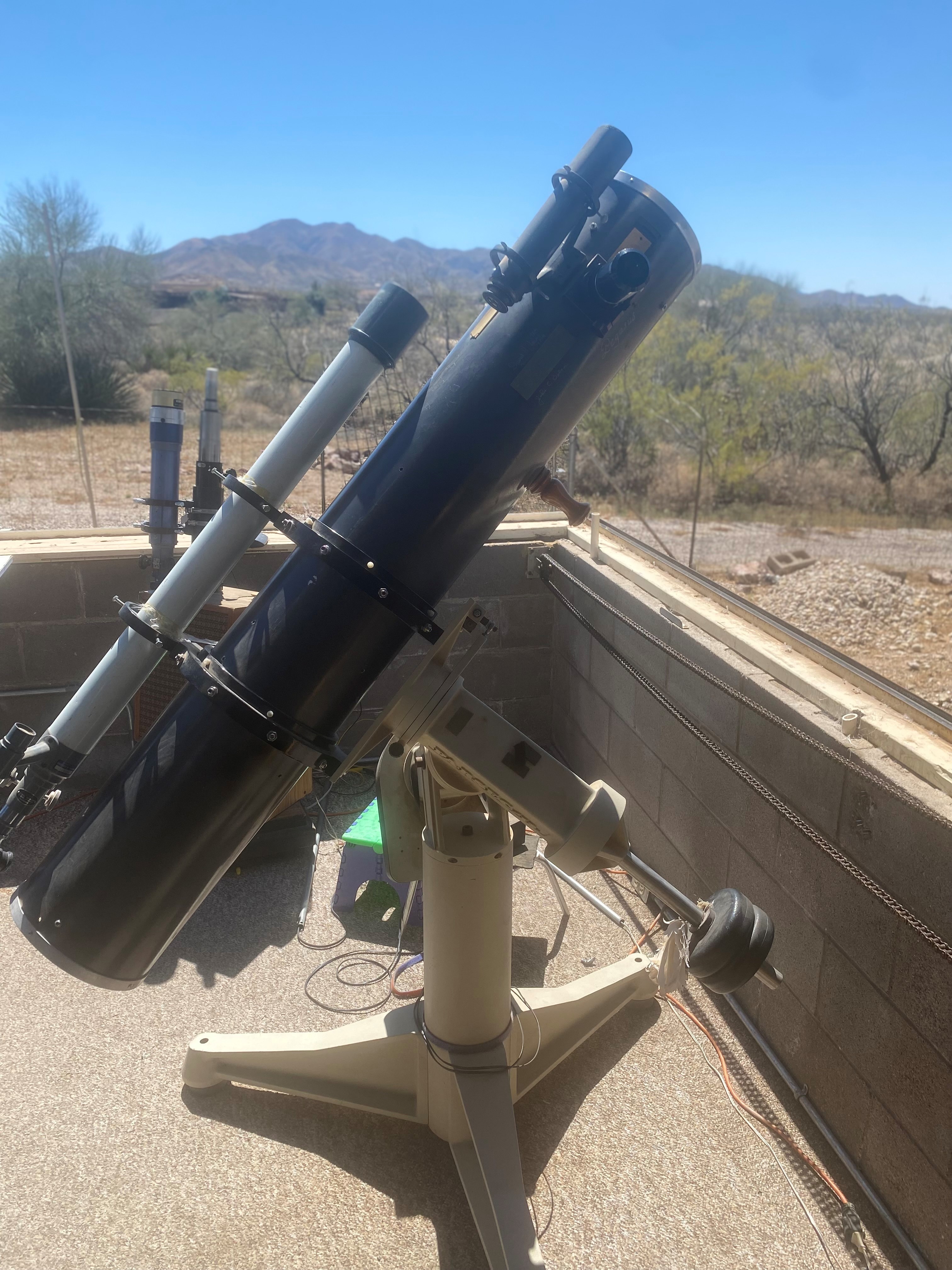
 

Pegasus of Carl

Pegasus Orignial

Tuesday, January 4, 2022

Local doll museum previews open house

Local doll museum previews open house: Did you have a favorite doll as a kid? Executive Director Ellen Tsagaris joined us today to talk about how the American Doll and Toy Museum celebrates all kinds of toys. For more information visit …

Saturday, November 13, 2021

November 2021 Skyward by guest blogger Dr. David Levy


Skyward


November 2021


By


David H. Levy


Galaxies, just for the sake of argument


M31 Andromeda Galaxy Summer 2021

          A few weeks ago, I received a message from Cameron Gillis, an amateur astronomer who wrote that he liked galaxies.  Just for fun, I decided to take the opposite approach, a philosophical reversal.  If he likes galaxies, then I hate them.  As we prepared for our meeting I began to explain the various reasons why I hate them.  When, for example, I am observing with a telescope and the Andromeda galaxy enters my field of view, I quickly leave the telescope and ride my bicycle to the end of our driveway and back.    The more I stretch the story the greater the laughter becomes.  I especially get annoyed by the dark Hydrogen-II regions that stretch across  its hideous girth.  The cluster of galaxies in the Virgo cluster, particularly Messiers 84 and 86, are so bland that  I sometimes have to leave the telescope altogether!     

          The worst galaxy is our own.  When I look up at the evening sky, the Milky Way obstructs my view as it straddles the night from Cassiopeia all the way down to Sagittarius.      The stars are so thick that I can hardly see black sky between them.  Except of course, when I come across Baade’s window.  This area of sky  rattles me because there,  some darkness appears.  Discovered by Walter Baade, this window allows us to see almost to the center of our galaxy.  It is an awful sight.    The majesty of the night is nowhere more apparent than when I am viewing the center of our galaxy, in Scorpius and in Sagittarius, through my telescope.  It is wondrous.  So wondrous that I still hate it.  Because it wastes my time when I am mesmerized by it, the emotion of viewing the galaxy from my backyard is so strong that it strengthens my heart and pierces my soul.

          The worst part of seeing our own galaxy on a clear autumn night is that the dark lanes of hydrogen dust straddle its length. Dark areas are called giant molecular clouds.  They are not lit by nearby stars; they just are there.  In the far distant future, they will generate new systems of stars and planets like our Earth.  They are called giant molecular clouds or Hydrogen  (H II) regions.

          In distant external galaxies, dark clouds like these can straddle their whole length.   The Andromeda galaxy has several of these H II regions that one can observe through a small telescope if one looks carefully enough.

          Deep in the southern sky, but still visible from most of North America, lies Caroline Herschel’s galaxy.  It is No. 253 in the NGC, the New General Catalogue.  Under a bright sky it is hardly anything, but from a dark site it resembles a long resting caterpillar. It has a most prominent dark hydrogen lane running across its length.

          Along with  globular star clusters, those round conglomerations of hundreds of thousands of stars that orbit the outskirts of galaxies, including our own, galaxies are the oldest structures in  the Universe.  The oldest ones started to build within half a million years of the Big Bang, when the Universe was in its infancy.


          So much for hating galaxies.   When I say that I hate them, I write merely for the sake of argument and humor.  Galaxies are almost like people, each one different, each one with its special characteristics.  One way of looking at them is to compare their gigantic sizes with our puny selves.  But there is another way.  Small as we may be, each of us is unique.  Galaxies  are huge, but aside from their differing shapes, they are still much alike.    But in all this Universe, among all these galaxies, there is just one, only one, of each of us.  Our ideas, our personalities, are precious.

Sunday, October 31, 2021

Dr. E's Doll Museum Blog: Halloween 2021

Dr. E's Doll Museum Blog: Halloween 2021:   It is finally Halloween; I literally wait all year. All of October intoxicates me; I love the turning leaves, the pumpkins and gourds, the...


Saturday, October 16, 2021

Wednesday, September 29, 2021

American Doll and Toy Museum: American Doll and Toy Museum is Open!!

American Doll and Toy Museum: American Doll and Toy Museum is Open!!:  Yes, it's true!  Our preview was a smash, and our regular hours for a while will be Saturdays 11-3 or by appointment. We welcome groups...

z
Erzebet's bathroom, part of our Storyland


Tuesday, February 16, 2021

American Doll and Toy Museum: Thinking outside the Doll House, A Memoir, is now ...

American Doll and Toy Museum: Thinking outside the Doll House, A Memoir, is now ...: Here is the link: Thinking outside the Doll House:  https://www.amazon.com/Thinking-Outside-Doll-House-Memoir-ebook/dp/B08W9QFPB9/ref=sr_1_1...

Here it is after 17 years of research and constant editing and rewriting; Thank you Dr. Roald Tweet.  This is the story of us, our museum, me, my friends and family, and of course, the dolls.

Erzebet is mentioned!